 Actions Therapy
Media Feature
Psychodrama Allows Participants to Release Emotions Through Role-Play
A Lianhe Zaobao feature on how counsellor Carolyn Lim uses psychodrama and role-play to help participants explore emotion, relationship, and inner conflict.
When psychology or psychological counselling is mentioned, many people immediately picture a helper and a therapist sitting face-to-face and talking.
In reality, psychological counselling can take many more forms than most people imagine. In recent years, increasing numbers of people have explored their inner worlds and personal growth through psychodrama.
With the guidance of a psychodrama facilitator, participants explore emotions, relationships, inner conflicts and unresolved issues through role-play and re-enactment. In the process, they come into contact with deeply held feelings, organise emotions that have long been suppressed, and experience a sense of release.
Carolyn Lim, a counsellor at Care Corner Counselling Centre, told Lianhe Zaobao that psychodrama is an experiential form of psychotherapy. Through action, role-play, group interaction and spontaneity, it helps people explore their emotions, relationships, inner conflicts and unresolved life experiences.
“It provides a safe and creative space for hidden stories to emerge and emotions to be explored. People may develop deeper understanding, insight and a sense of release, and discover healthier and more integrated ways of living.”
The Difference Between Psychodrama and Traditional Counselling
The main differences between psychodrama and conventional counselling lie in three areas.
1. Focus
Psychodrama focuses on present emotions, relationships and inner conflicts.
Traditional counselling generally explores issues through dialogue.
2. Method
Psychodrama is action-oriented and places emphasis on embodied experience.
Traditional counselling is primarily based on verbal conversation, reflection and exploration.
3. Experience
Psychodrama recognises that “the body remembers” and works therapeutically through experiential processes.
Traditional counselling mainly relies on language and cognition.
Carolyn, who has worked in mental health and trauma counselling for many years, quoted a common saying among psychodrama practitioners:
“We are not just talking about the problem; we are acting it out.”
She also emphasised:
“You don’t need experience. You only need to remain curious.”
A Psychodrama Session Has Three Main Stages
The role of the psychodrama facilitator is much like that of a director, guiding participants into a meaningful and therapeutic dramatic experience.
A typical psychodrama session consists of three stages.
1. Warm-up
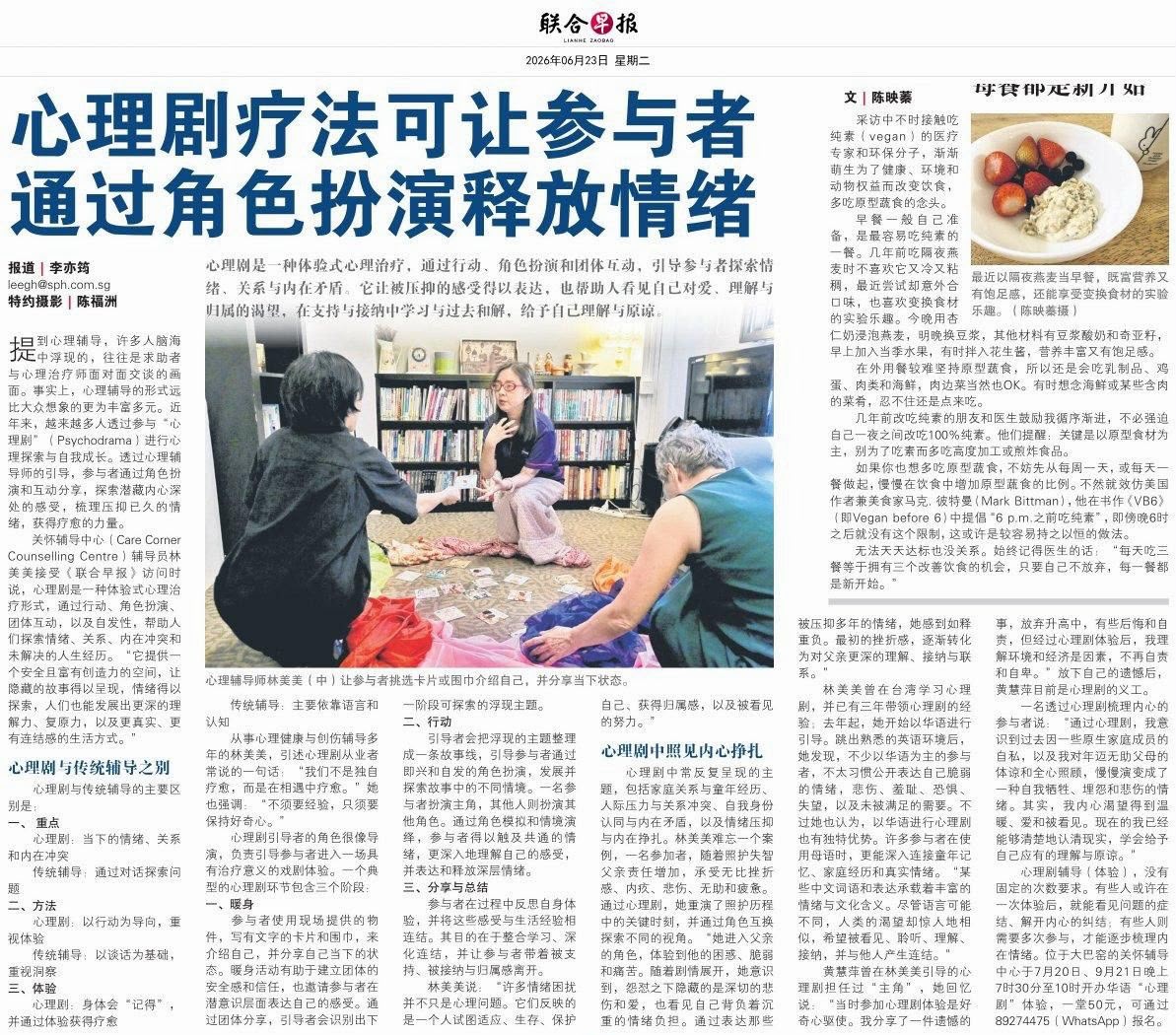
Participants use materials available in the room, such as cards with words or pieces of cloth, to introduce themselves and share their present state.
Warm-up activities help build a sense of safety and trust within the group. Participants are also invited to express their feelings at the level at which they feel comfortable.
Through group sharing, the facilitator can identify themes that are beginning to emerge.
2. Action
The facilitator organises the emerging themes into a storyline and guides participants to use improvisation and spontaneous role-play to develop and explore different situations.
One participant may take the role of the protagonist, while others play other significant roles.
Through role reversal and scene enactment, participants can examine their experiences and emotions from different perspectives, develop greater understanding of their own feelings, and express and release deeply held emotions.
3. Sharing and Integration
Participants reflect on their experiences during the session and connect those feelings with their own life experiences.
The purpose is to integrate learning, deepen connections and allow participants to experience support, acceptance and belonging rather than leaving the session emotionally exposed.
Carolyn explained:
“Many emotional difficulties are not simply psychological problems. They reflect how a person has adapted, survived and protected themselves, how they have developed a sense of belonging, and how they have tried to be seen.”
Seeing Inner Struggles Through Psychodrama
Themes that frequently appear in psychodrama include family relationships and childhood experiences, interpersonal stress and relationship conflicts, self-identity and inner contradictions, as well as emotional suppression and internal struggles.
Carolyn vividly remembers one particular case.
A participant had gradually taken on greater responsibility for caring for her father, who was experiencing cognitive decline. She carried tremendous frustration, inner conflict, sadness, helplessness and exhaustion.
Through psychodrama, she re-enacted key moments from her caregiving experience and explored different perspectives through role reversal.
“She stepped into her father’s role and experienced his difficulties, vulnerability and pain.”
As the drama unfolded, she began to recognise that beneath her resentment lay profound sadness and love. She also saw how much emotional burden she herself had been carrying.
By expressing these long-suppressed emotions, she experienced a sense of release. Her initial frustration gradually transformed into a deeper understanding, acceptance and connection with her father.
The Unique Power of Using One’s Mother Tongue
Carolyn studied psychodrama in Taiwan and already had about three years of experience leading psychodrama. Beginning last year, she started facilitating sessions in Mandarin.
After moving beyond the familiar environment of conducting sessions in English, she discovered that many primarily Mandarin-speaking participants were unaccustomed to openly expressing vulnerable emotions such as sadness, shame, fear, disappointment and unmet needs.
However, she also found that conducting psychodrama in Mandarin has unique advantages.
Many participants are able to connect more deeply with childhood memories, family experiences and their authentic emotions when using their mother tongue.
“Certain Chinese words and expressions carry rich emotional and cultural meanings. Although our languages may differ, the human longing is remarkably similar—we want to be seen, heard, understood and accepted, and we want to connect with others.”
From Regret and Self-Blame to Understanding and Forgiveness
Huang Huiping once took the role of the “protagonist” in a psychodrama session facilitated by Carolyn.
She recalled:
“At the time, I joined the psychodrama experience out of curiosity. I shared something I regretted—giving up my studies in senior high school. I carried regret and self-blame about it.”
However, after experiencing psychodrama, she came to understand that environmental and financial circumstances had contributed to her decision.
“I stopped blaming and shaming myself.”
After releasing her regret, Huang Huiping later became a volunteer in psychodrama.
Another participant who went through the psychodrama process said:
“Through psychodrama, I realised that because of the selfishness of some members of my family of origin, and because of my experiences of helplessly caring for my elderly parents, I gradually developed feelings of self-sacrifice, resentment and sadness.”
The participant continued:
“Deep inside, what I actually longed for was warmth, love and to be seen. Now I can recognise reality more clearly and learn to give myself the understanding and forgiveness I deserve.”
How Many Psychodrama Sessions Are Needed?
There is no fixed number of sessions required for psychodrama.
Some people may gain insight after just one experience, recognise the symptoms of a problem and begin to untangle their inner knots.
Others may need to participate several times before they can gradually sort through deeper emotions.
The article concludes by noting that the Care Corner Counselling Centre will conduct Mandarin psychodrama experiential sessions on 20 July and 21 September, from 7:30 p.m. to 10:00 p.m. The fee is S$50 per session, with registration available via WhatsApp.
https://www.zaobao.com.sg/lifestyle/health/story20260623-9221515